Live Roller Conveyors in Houston, TX — Transport, Accumulate, Divert & Merge on Powered Rollers
When cartons need to accumulate without crushing, divert onto spurs, or flow through powered curves, live roller conveyor is the answer. Lone Star Automated Systems designs, supplies, and installs BDLR, zero pressure, lineshaft, and 24VDC motorized roller systems across Texas.
Product Rides Directly on Powered Carrying Rollers
Belt-driven live roller (BDLR) is a powered conveyor where the load is carried directly on carrying rollers. An endless flat or V-belt runs beneath them, and adjustable-height pressure rollers press that belt up against the carrying rollers — transferring drive power to whatever sits on top.
Because the carrying surface is rollers rather than a belt, product can accumulate, divert onto 30° spurs, merge from extended-width sections, stop against pop-up stops, and change direction through powered curves — the capabilities that make live roller the backbone of distribution and order fulfillment systems.
BDLR is designed for level applications up to 5° of pitch, conveying product with a flat, firm bottom surface — typically up to a 150 lb unit load or 50 lb per foot live load. Heavier pallet loads move on pallet handling conveyor; lighter fixed-spacing work belongs on belt conveyor.
Six Jobs One Live Roller Line Can Do
Move product point to point on powered rollers with minimal drives.
Store or stage product in low pressure or zero pressure zones without crushing cartons.
Send cartons onto 30° spurs by manual or automatic means for sortation and order routing.
Combine flows from extended-width merge sections into a single lane.
Stop and release product automatically or manually anywhere along the line.
Change direction without transfer points using V-belt driven live roller curves.
Live Roller Systems We Design & Install
Each drive technology suits a different duty. We'll match the right one to your rates, load profile, environment, and budget — and combine them in a single system where it makes sense.
Low Pressure Accumulation
A low-friction belt drives rollers whose bushings ride in 5° angular slots. When a load meets an obstruction, the bushings roll up the slot and relieve belt pressure under the load — so cartons accumulate with only light contact. Best for solid, well-packed, non-fragile loads.
Typical range: line pressure averages 4–6% of accumulated weight • end drive with 325 lb effective belt pull, or center drive with 650 lb.
Zero Pressure Accumulation (ZPA)
A flat continuous belt drives short pressure-roller sections raised by air pods; zones lower their pressure rollers during accumulation so cartons stop with zero line pressure. Mechanical sensor rollers or photoeyes control each zone with singulation, slug, or smart release modes — smart release keeps sensor rollers below the carrying surface until needed, reducing product marring.
Typical range: speeds up to 300 FPM • runs up to 196 ft on a single drive • dual sensor rollers for tapered totes • programmable 120VAC zone control (PZC) or 24VDC photoeye modes available.
Lineshaft Live Roller
A rotating shaft runs the length of the conveyor, and each roller is driven by an elastomeric band on a slip-fit spool — so one motor powers curves, spurs, and straight sections together. Bolted construction and quick-coupled shafting make changes and additions easy, and sections can be customized as non-powered workstations, accumulation areas, or reverses on a common shaft.
Best for: clean, dry, quiet applications — clean rooms, electronics assembly, pharmaceuticals — with low case rates. Capacity: up to 60 lb per foot at standard speeds to 120 FPM. Avoid for: wet, oily, abrasive, or corrosive environments, elevation changes, or single-drive runs over 200 ft.
Powered Roller (Motorized Roller)
Low-voltage 24VDC motors live inside individual rollers placed along the conveyor, each driving its zone's carrying rollers through 3/16" urethane belts. The result is quiet, run-on-demand transportation and true zero pressure zone accumulation — sections can be as short as a single zone.
Typical range: level transportation and ZPA • inclines/declines to 5° with 3" flat belts and loads to 75 lb • steeper angles possible with lighter loads.
V-Belt Driven Live Roller
Curves, 30°/45° spurs, and skewed sections driven by a continuous "B" size V-belt held against the rollers by pressure sheaves — designed for transportation, not accumulation. Sheaves are set with just enough contact to move product without stalling, which prolongs belt life.
Application rules: drive from the infeed end where possible • divert spurs run 15% faster than the feeding conveyor; reversed-flow spurs run 15% slower than the takeaway.
Skewed & Flexible Powered Roller
Skewed live roller angles its rollers to align cases to one side of the conveyor — the standard infeed for accumulation of multi-width cases, sortation, and bar code scanning. Present product with gaps between cases; flat-bottomed, normal-to-heavy corrugated works best, minimum box height 1".
Flexible powered roller brings live roller drive to expandable, portable sections — ideal for truck loading and unloading, distribution centers, packaging, portable assembly, and shipping/receiving, with accumulation options available.
Skewed capacity: 400 lb total live load • 150 lb maximum unit load.
Low Pressure vs. Zero Pressure vs. MDR at a Glance
| Factor | Low Pressure Accumulation | Zero Pressure (ZPA) | 24VDC Motorized Roller |
|---|---|---|---|
| Line pressure | Light — averages 4–6% of accumulated weight | Zero — zones stop cartons without contact | Zero — zones stop independently |
| Best for | Solid, well-packed, non-fragile loads | High-rate distribution and fragile or mixed cartons | Quiet, energy-efficient, run-on-demand zones |
| Controls | Mechanical — none required | Sensor rollers or photoeyes; singulation, slug, smart release | 24VDC photoeyes; singulation or slug release |
| Notable specs | 325 lb (end drive) / 650 lb (center drive) belt pull | To 300 FPM; 196 ft on one drive | Loads to 75 lb; inclines to 5° |
Live Roller Conveyor FAQs
What is a live roller conveyor?
A live roller conveyor is a powered conveyor where product rides directly on motor-driven carrying rollers rather than on a belt. The rollers can be driven by a flat belt underneath (BDLR), a V-belt, a rotating lineshaft, or 24VDC motorized rollers. Because the carrying surface is rollers, live roller excels at accumulation, diverting, merging, and powered curves.
What is the difference between live roller and belt conveyor?
On a belt conveyor, product rides on a continuous moving belt, which keeps spacing and orientation fixed and handles irregular loads. On live roller, product rides directly on powered rollers, which lets cartons accumulate with low or zero line pressure, divert onto spurs, merge, and take powered curves — but loads need a flat, firm bottom, typically up to 150 lb per unit or 50 lb per foot.
What is zero pressure accumulation (ZPA)?
Zero pressure accumulation is zone-based live roller conveyor that removes drive power from a zone as product accumulates, so cartons stop without touching each other. Zones are controlled by mechanical sensor rollers or photoeyes with singulation, slug, and smart release modes. ZPA runs at speeds up to 300 FPM, and runs up to 196 feet can be powered by a single drive.
When should I use lineshaft conveyor?
Lineshaft shines in clean, dry, quiet applications with low case rates and short runs that include many components — clean rooms, electronics assembly, pharmaceuticals. One motor drives the whole shaft, so it needs fewer drives and controls, cutting energy, installation, and maintenance costs. Avoid it in wet, oily, abrasive, or corrosive environments, on elevation changes, and on single-drive runs over 200 feet.
What is a 24VDC motorized roller (MDR) conveyor?
MDR conveyor puts low-voltage 24VDC motors inside individual rollers, each driving its zone's neighbors through urethane bands. It delivers quiet, energy-efficient transportation and true zero pressure accumulation, runs only when product is present, and handles loads to about 75 lb with inclines and declines up to 5°.
Does Lone Star Automated Systems install live roller conveyors in Houston?
Yes. We're headquartered in Houston, TX and provide layout, design, supply, and installation of live roller systems — including accumulation, sortation infeeds, curves, spurs, and controls — throughout Houston, the Gulf Coast, and all of Texas. Call 713-532-4444 for a quote.
Live Roller Conveyor Design & Installation Across Texas
Lone Star Automated Systems is headquartered at 2500 Citywest Blvd., STE 150, Houston, TX 77042 and serves distribution centers, e-commerce fulfillment operations, manufacturers, and warehouses throughout the Gulf Coast and statewide.
Ready to Spec Your Live Roller System?
Tell us your carton sizes, rates, and how much accumulation you need. We'll recommend the right drive technology — BDLR, ZPA, lineshaft, or MDR — and quote the complete system with controls.
713-532-4444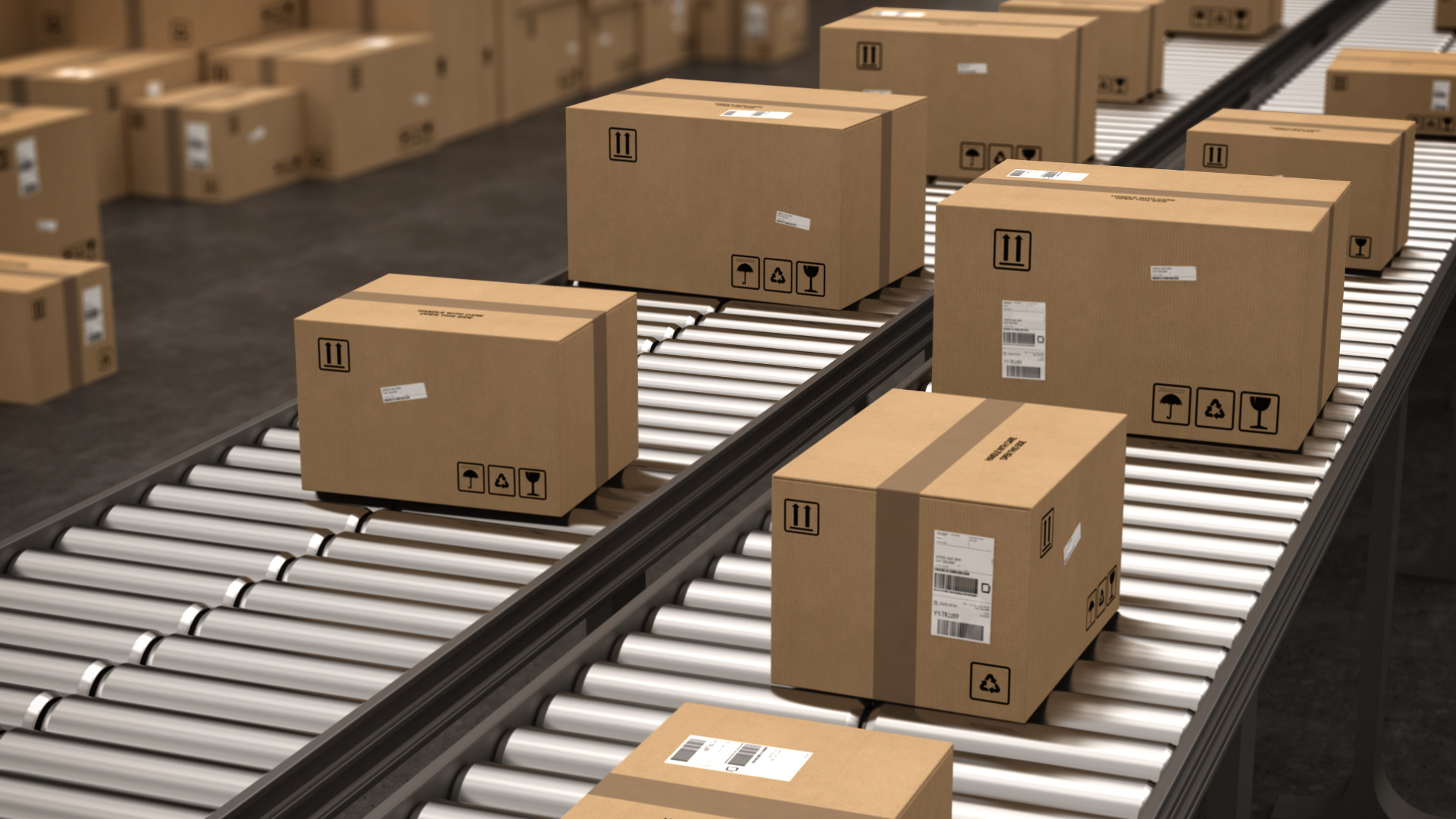
Belt Driven Live Roller Conveyors
Belt driven live roller is a powered conveyor where the load or product is carried directly on carrying rollers. An endless belt (flat or V belt) drives the carrying rollers. Adjustable height pressure rollers located below the carrying rollers engage the belt with the carrying rollers, providing the power to transport the product. BDLR conveyors are designed for level applications that do not exceed 5° of pitch. The product to be conveyed should have a flat and firm conveyable surface and a maximum unit load weight of 150 lb or a live load of 50 lb per ft.
Belt driven live roller is a commonly used conveyor due to the variety of its applications. Following are a few typical applications:
Transportation - moving product from one point to another.
Accumulation - product must be stored or staged.
Diverting - onto 30° spurs, by manual or automatic means.
Merging - from extended width sections.
Pop-up Stops - automatic or manual.
Changing directions - live roller curves.
Low Pressure Accumulation
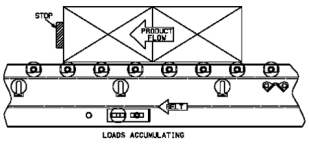
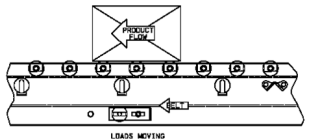
This type of belt driven live roller conveyor employs a low friction belt and is used to accumulate loads of a solid, well packed non-fragile nature.
The carrying rollers are equipped with bushings that ride in a 5° angular slot. The high side of the slot is opposite the direction of load travel. As the load moves along the conveyor, the carrying roller bushings rest at the bottom of the slot.
As soon as the load meets an obstruction, such as a blocked load, the belt motion causes the carrying roller bushings to roll up the angular slot, thus relieving some of the pressure between the belt and carrying rollers under the load.
The line pressure developed from the accumulation of loads varies depending on such factors such as size, shape, and weight of loads, but, in general, the line pressure exerted on the lead carton averages 4% to 6% of the total accumulated weight on the conveyor.
Two models of low pressure accumulation are available: an end drive that has a 325 lb effective belt pull capacity and a model that is equipped with a center drive and has a 650 lb effective belt pull capacity.
Zero pressure conveyor
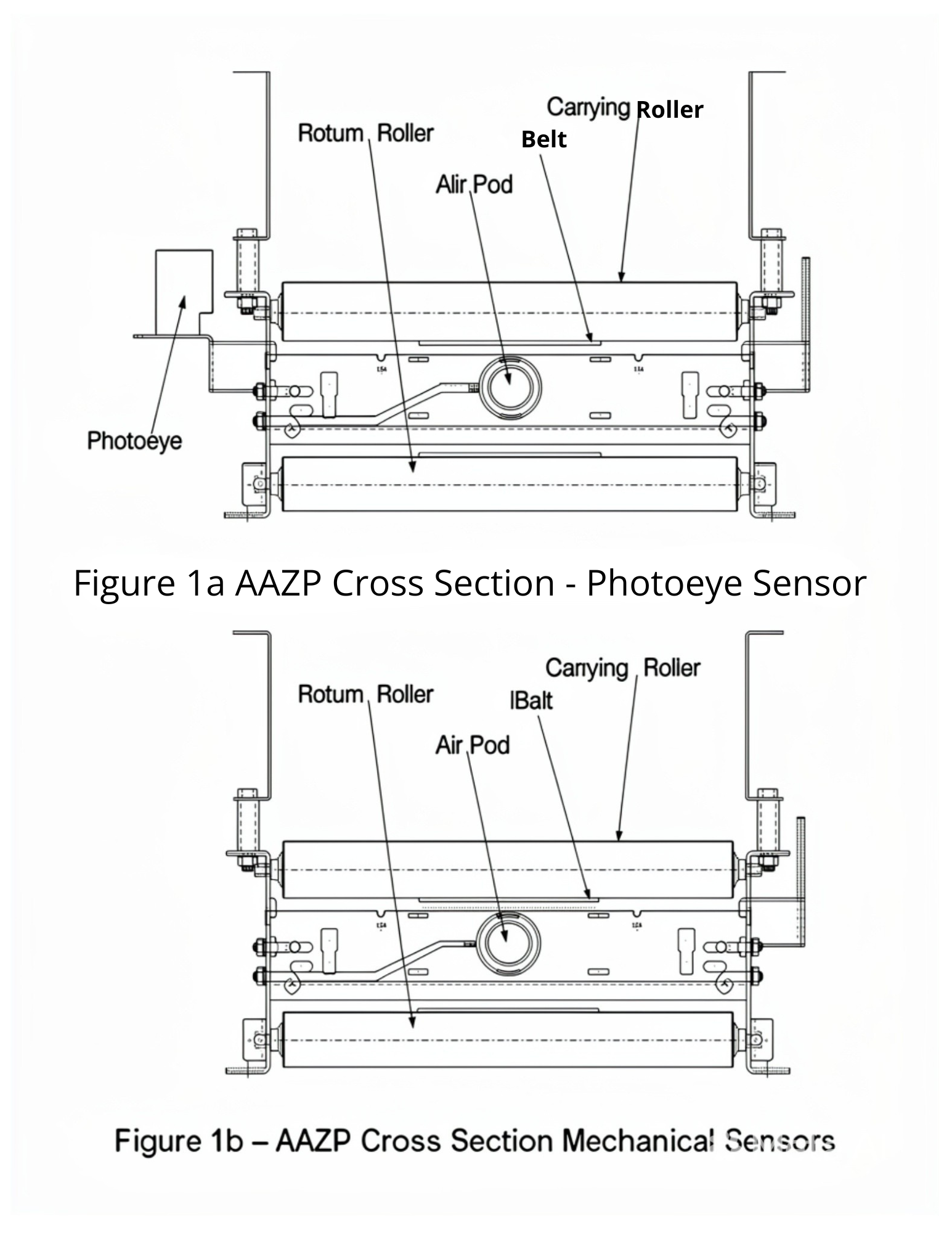
Zero Pressure Conveyor is a belt driven, zone accumulating, live roller conveyor. It is driven with a flat continuous belt. Pressure rollers, mounted in short sections, are raised vertically by air pods to bring the belt into contact with the underside of the carrying rollers to provide the driving force. Pressure rollers are lowered during accumulation. See Figure 1a & 1b Cross Sections for reference. Mechanical sensor rollers or photoelectric sensors control the flow of product and are located in each accumulation zone. Two different zone lengths and carrying roller centers are available to convey a wide range of carton sizes. Multiple modes of operation, for mechanically and photoelectrically controlled conveyors, are available for meeting a wide range of throughput rates and application requirements.
Zero Pressure Conveyor is designed for horizontal, non-reversing applications operating at speeds up to 300 feet per minute with the following benefits:
Zero line pressure when product is accumulated.
Singulation, Slug, or Smart Release Modes of operation for mechanical sensor rollers.
Smart release allows sensor rollers to remain below carrying surface until needed, reducing marring of product, and increasing life of the equipment.
Dual sensor rollers accumulate product with tapered ends such as totes.
Conveyor lengths up to 196 ft long can be powered by a single drive.
Programmable 120VAC photoelectric mode of operation (PZC - Programmable Zone Control) available.
DC Accumulation with 24VDC photoeyes is available in two modes of operation, singulation and slug release.
Line Shaft Live Roller
Line Shaft live roller
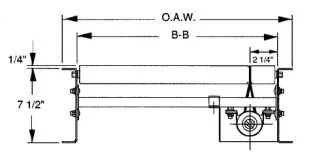
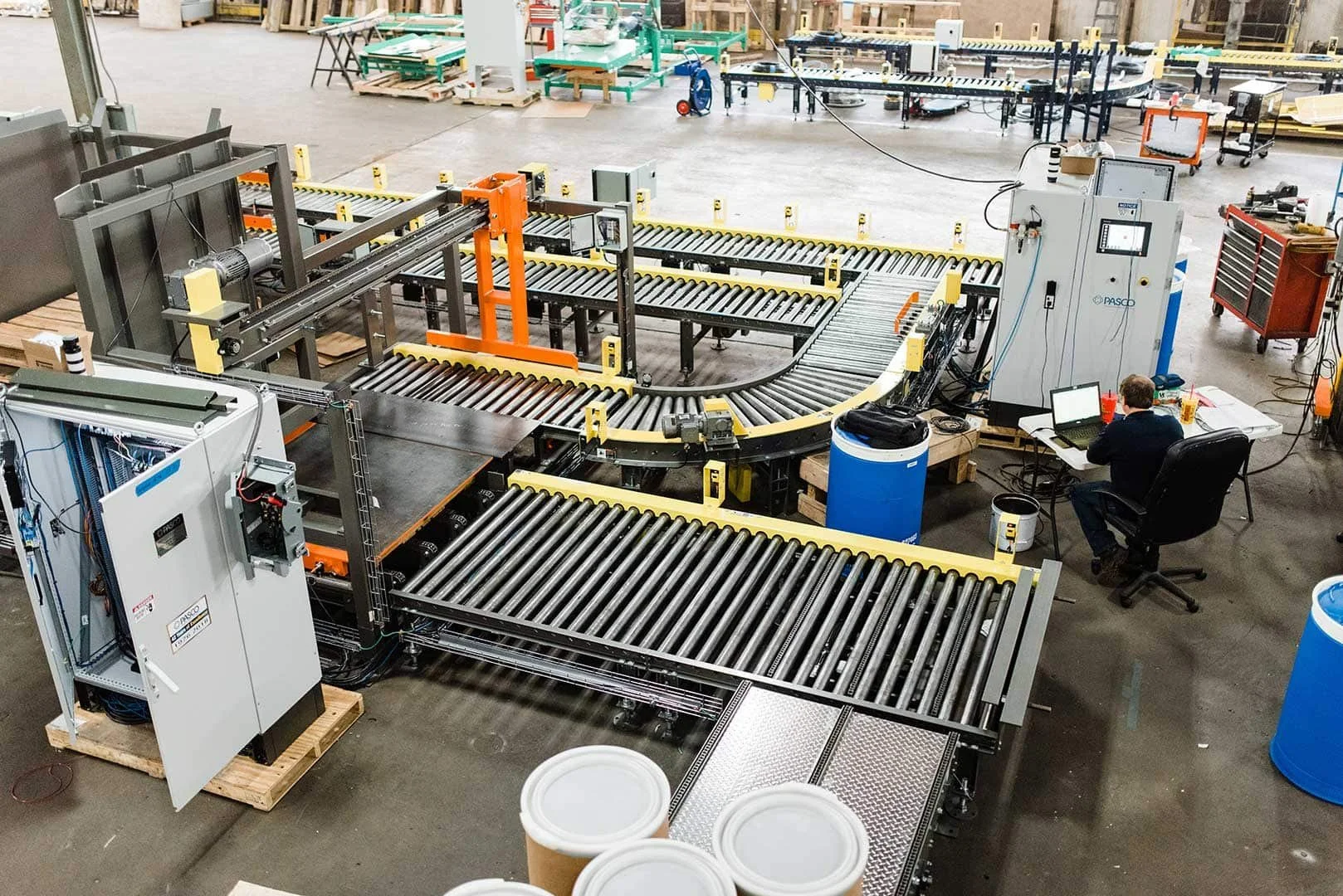
Line Shaft is a live roller conveyor driven by a shaft which runs the length of the conveyor. Each roller is individually driven by an elastomeric belt connected to a slip fit drive spool on the line shaft. Since several components can be powered by one motor, Line Shaft is an economical solution in many applications. Line Shaft conveyors are ideal for applications such as clean rooms, electronic assembly areas and pharmaceuticals to create a clean, quiet, and flexible system. Loads up to 60 pounds per foot can be moved at standard speeds up to 120 fpm.
Bolted construction and quick-coupled shafting easily accommodate changes or additions. Individual rollers or sections of the conveyor can be customized to create non-powered work stations, accumulation areas, or reverses in direction of travel on a common driveshaft.
Line Shaft conveyor requires fewer drives and controls resulting in lower energy consumption and lower installation and maintenance costs than conventional conveyor.
Line Shaft conveyor should be considered when the following conditions exist:
Low case rate.
Clean and dry application.
Quiet application.
Short conveyor runs with a high number of components.
Line Shaft conveyor should not be considered when the following conditions exist:
Wet or oily environment.
Abrasive or corrosive environment.
Elevation changes.
On conveyors over 200 ft long with one drive.
Powered roller
Powered roller is a live roller conveyor where the load or product is carried directly on the carrying rollers. The carrying rollers are driven from 24Vdc motorized rollers that are strategically located along the length of the conveyor in transportation or accumulation zones. Drive belts, 3/16" diameter urethane, connect the motorized roller to carrying rollers in each zone.
Powered roller conveyor is designed for level transportation and zero pressure zone accumulation applications. Equipped with 3" wide flat belts, Powered roller conveyor can be used in inclining and declining applications up to 5 degrees and loads weighing up to 75 lbs. Greater angles of incline can be achieved with lighter loads.
Powered roller conveyors can be comprised of several sections, each of which may consist of several zones. The conveyor can be as short as a single zone.
V-Belt Driven Live Roller
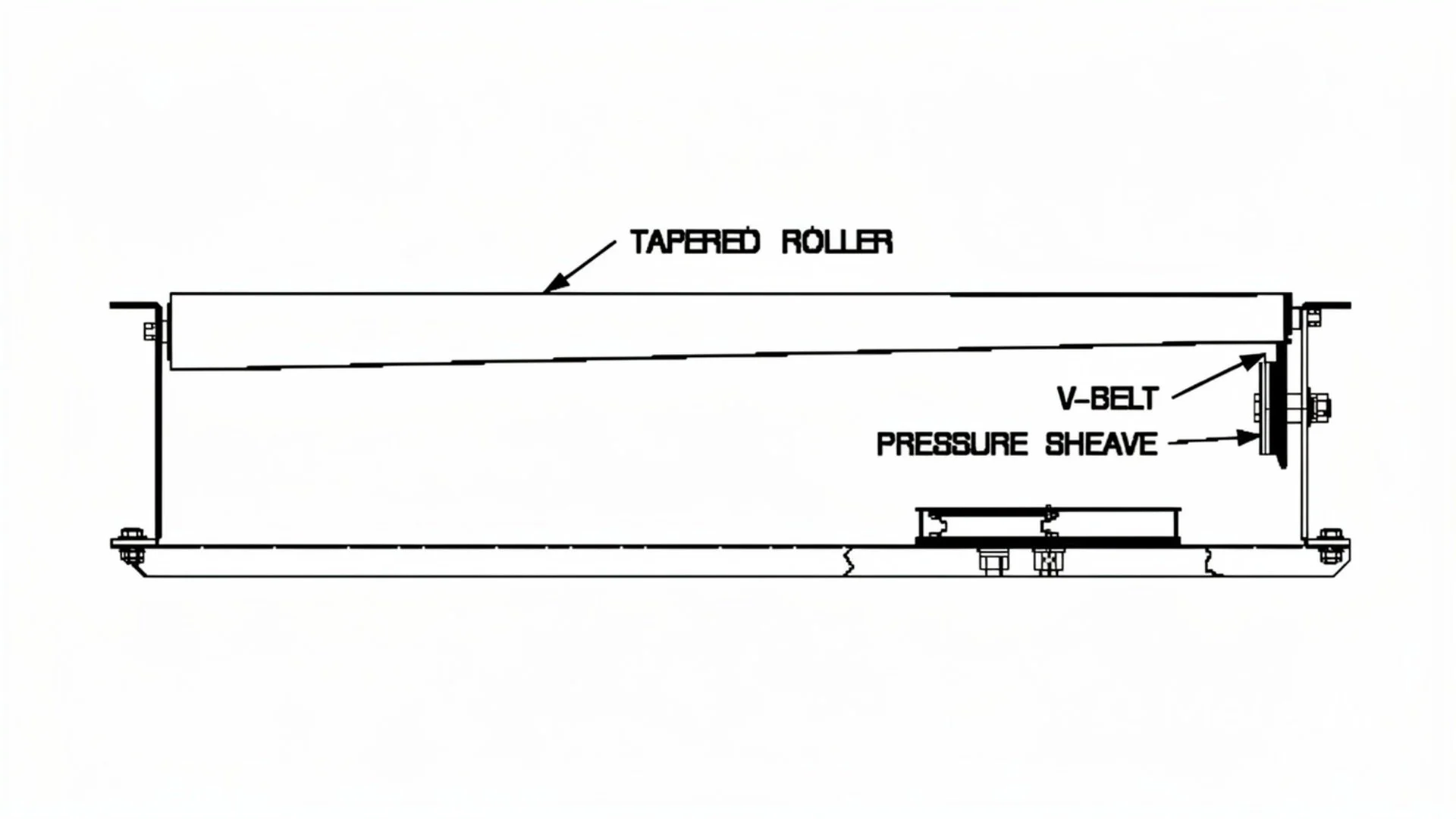
V-belt driven live roller curves, spurs, and skewed live roller are designed to transport product and should not be used for accumulation. All rollers are driven by a continuous "B" size V-belt. Pressure sheaves hold the V-belt against the underside of the carrying rollers. To prolong belt life, the pressure sheaves should be set to provide just enough contact between the belt and carrying rollers to move the product without stalling.
The preferred end for driving all belt driven live roller units is at the infeed end. However, lightly loaded curves, can be driven successfully from the discharge end.
When diverting to a spur or spur-curve at a 30° or 45° angle, the speed of the spur should be set to run 15% faster than the conveyor feeding it. Conversely, if the product flow is reversed with travel from the spur to a takeaway conveyor the spur speed should be set 15% slower than the take-away conveyor.
Skewed live roller conveyor
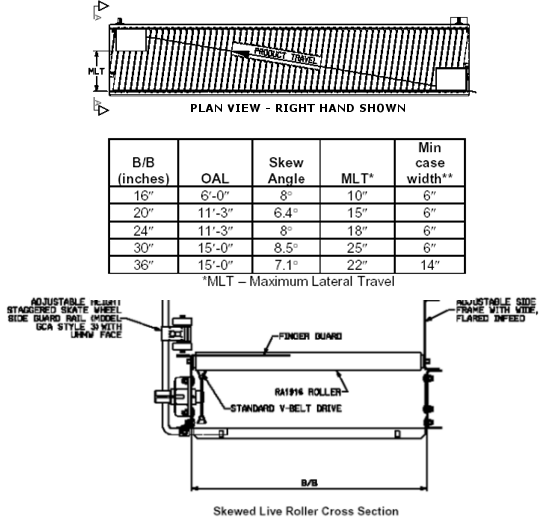
Skewed live roller conveyor is sometimes used at the infeed end of an accumulation conveyor to align the packages to one side of the conveyor. Typical applications for edge alignment include: accumulation of multi-width cases, sortation, and bar code scanning.
**The minimum width case that will edge align according to the skew and overall length of the conveyor. The minimum width dimension assumes the case enters the skewed live roller conveyor along one guardrail and travels the full width across the conveyor to the other guardrail at the discharge end. Capacity of 400 lbs total live load, maximum unit load of 150 lbs. Normal-to-heavy corrugated cardboard with flat bottom is preferred. Minimum box height = 1". For applications with open flaps or totes, consult factory.
Product should be presented to the skewed live roller conveyor with gaps between the cases for optimum operation. There is always a potential for cases that are square or wider than they are long, to spin around as they make contact with the skate wheel guardrail.